

Last Updated: November 12, 2026
Quick Summary
Daycare performance reviews work best when they are a continuing conversation rather than a single yearly event. Most guidance points to one formal review a year, supported by monthly or quarterly check-ins where most real development happens. Each review should cover core responsibilities, observed practice, professional growth and an agreed plan for the next period.
- Annual reviews are common, with 56.3% of organizations reviewing performance once per year in a 2026 report.
- Recommended rhythm is one formal review a year, or two biannual reviews in some cases.
- Hold monthly or quarterly check-ins between formal reviews, where most development happens.
- Tie review criteria to the actual job description so staff are judged only on what they were asked to do.
- Base reviews on dated classroom observation notes and a short staff self evaluation completed before the meeting.
Table of Contents
- Why Daycare Performance Reviews Matter for Staff Retention
- How Often to Review Daycare Staff and What a Review Should Include
- Preparing for the Review: Observation Notes and Self Evaluation for Child Care Workers
- Using a Childcare Staff Evaluation Form Your Team Can Trust
- Writing Child Care Employee Evaluation Comments That Are Specific and Fair
- Running the Conversation: What to Say and What to Avoid
- Following Up So Reviews Lead to Real Change in Your Centre
- Frequently Asked Questions
Why Daycare Performance Reviews Matter for Staff Retention
Staff turnover is one of the hardest problems in early learning, and well-run daycare performance reviews are one of the most practical tools you have to address it.
Many services treat reviews as a once-a-year obligation.
The problem with waiting twelve months is simple. By the time a concern reaches the review table, it has usually been sitting unspoken for months.
Frequent, honest feedback changes that dynamic. Read how regular feedback connects to keeping educators.
How Often to Review Daycare Staff and What a Review Should Include
Most practical guidance lands on the same rhythm: one formal review each year, supported by more regular check-ins.
A formal review should cover four things: the role's core responsibilities, observed practice in the room, professional growth since the last review, and an agreed plan for the next period. Keep the criteria tied to the actual job description so nobody is being judged on something they were never asked to do.
Some services also use performance-management software to track feedback between reviews. Software is optional. A shared notebook with dated entries works just as well if you keep it consistent.
The article points to a clear rhythm and a core set of review areas, which are summarised below.
| Element | What it looks like | Frequency or note |
|---|---|---|
| Formal review | Annual review, or two biannual reviews in some cases | Once a year, or twice |
| Check-ins | Regular conversations between formal reviews | Monthly or quarterly |
| Core responsibilities | Tied to the actual job description | Every review |
| Observed practice | What happens in the room | Every review |
| Professional growth | Progress since the last review | Every review |
| Next-period plan | Agreed plan for the coming period | Every review |
Preparing for the Review: Observation Notes and Self Evaluation for Child Care Workers
A review is only as fair as the evidence behind it. Preparation is what separates a conversation grounded in specifics from one built on impressions.
Gathering Classroom Observation Notes
Take brief, dated notes during regular visits to rooms. Write down what you saw and heard, not what you concluded. "Read a story to a small group, invited quieter children to join, redirected two children calmly" is useful.
Aim for a handful of observations per educator each term, spread across different times of day. This gives you a balanced picture rather than a snapshot from one busy Tuesday.
Asking Staff to Complete a Self Evaluation
Ask each educator to complete a short self evaluation before the meeting. Three or four prompts are enough, such as: What is a moment this term you felt proud of your practice?
Self evaluations often reveal things a leader would not otherwise see, and they signal that the review is a two-way conversation. Read them before the meeting so you can respond to what the educator has actually said.
Using a Childcare Staff Evaluation Form Your Team Can Trust
A good childcare staff evaluation form is consistent, short and linked to the role. Avoid forms with dozens of vague rating boxes. Instead, use a small number of clearly defined criteria, each with a description of what strong, developing and needs-support practice looks like.
Build Role-Specific Rubrics, Not One Form for Everyone
One of the most common fairness problems in early learning reviews is judging a lead educator, an assistant, a floater and a cook against the same list. Their jobs are not the same, so their criteria should not be either.
- Lead educators: room program design, intentional teaching, mentoring assistants, documentation of children's learning, family partnerships.
- Assistants: following the program, supporting transitions, supervision positioning, contributing to routines.
- Floaters and relief staff: settling into unfamiliar rooms quickly, picking up routines, asking for help, handover accuracy.
For each criterion, write three short descriptors: what strong practice looks like, what developing practice looks like, and what needs-support practice looks like. This is the single biggest lever for consistency, because two leaders looking at the same evidence should land in roughly the same place.
Use Behavior-Based Anchors to Reduce Bias
Subjective ratings creep in when criteria are adjectives ("enthusiastic", "professional", "warm"). Replace adjectives with observable behaviors.
Two habits sharpen this further. First, gather more than one observation per criterion, across different times of day and different rooms, so a single hard morning does not define the rating. Second, calibrate with another leader before finalising ratings.
Watch out: if you only ever observe during scheduled visits, you will see a performance of practice rather than practice itself. Build in some unannounced, brief walk-throughs so the evidence reflects what actually happens on an ordinary day.
Keep the Form Short Enough to Actually Use
A form with forty rating boxes will not be completed well. Aim for eight to twelve criteria in total, each with a short evidence note. If a criterion cannot be evidenced, it should not be on the form.
If you are looking for a template to adapt, tailor the criteria to your service's philosophy and approved learning framework. The template is the starting point, not the finished product.
Document Consistently and Confidentially
Keep review records in a secure, access-controlled location, separate from general staff files that other team members might see. Note the date, the evidence discussed and the agreed actions. If a concern relates to child safety or a serious conduct matter, follow your service's policies and seek advice before the review meeting rather than folding it into a routine performance conversation.
Writing Child Care Employee Evaluation Comments That Are Specific and Fair
Comments are where fairness is won or lost. Every comment should point to something observable, name the impact, and suggest a next step where relevant.
The Three-Part Comment Structure
A reliable pattern is: what you observed, what it meant for children or the team, and what happens next. This works for strengths as well as growth areas.
-
Vague: "Needs to be more engaged."
-
Specific: "During group time on Tuesday, you stayed at the back of the room. Moving to sit with the children would give you more chance to extend their conversations. Let's try this for two weeks and look at it together."
-
Vague: "Great with the babies."
-
Specific: "You noticed Theo was unsettled before rest time and sat with him, talking softly until he settled. That one-to-one attention is exactly what our youngest children need. Keep noting what works so we can share it with the rest of the room."
-
Vague: "Not a team player."
-
Specific: "At handover on Thursday, the afternoon educator was not told about the new allergy in the room. Walking through the handover sheet together before you leave would close that gap. Let's check in on this at the end of next week."
Connect Comments to Child Outcomes and Safety
Strong comments in early learning do not stop at "good with children." They connect practice to what children actually experience. When you write about supervision, inclusion, health and safety, family communication or developmentally appropriate practice, describe the behavior and its effect on children. "You adapted the obstacle course so the child using a walker could join in" says more about inclusion than any rating box.
Reduce Bias Before You Finalise
Subjectivity creeps in through personality language, comparisons with other staff and vague impressions. First, ask yourself whether a colleague looking at the same evidence would reach the same conclusion. Second, avoid describing personality ("a natural leader", "a bit quiet") unless you can show the behavior behind it. Third, check for patterns across your reviews: are you describing the same behaviors differently for different educators?
Watch out: comments written in a hurry at the end of a long day tend to drift into generalities. Draft them from your observation notes, not from memory.
Make Comments Part of an Ongoing Record
A comment should never be the first time an educator hears about a concern. If something needs addressing, it should already have been raised in a check-in, and the review comment should reference that conversation and the progress since.
Before finalising any comment, ask yourself whether you would be comfortable reading it aloud to the educator, and whether it points to a clear next step. If it does both, it is doing its job.
Running the Conversation: What to Say and What to Avoid
Open by stating the purpose: this is a chance to review the term together, celebrate what is going well, and agree on what to focus on next.

Do say things like "Tell me about the transition routine you designed" or "What do you think went well with the family conference?" Those invite reflection.
Avoid surprises, generalisations ("you always..."), comparisons with colleagues and anything that sounds like a warning when it is not.
For leaders who find these conversations uncomfortable, a shared structure helps. Step-by-step ways to improve team communication walk through what to say and how to say it. If you want to build the everyday trust these conversations depend on, trust-building ideas for childcare teams are a useful next read.
Following Up So Reviews Lead to Real Change in Your Centre
A review that ends in a filed document has failed. Agree on two or three concrete actions, set a date to check progress, and write them down where both of you can see them.
If staff have ignored feedback in the past, the reason is often that the follow-up was missing. Why staff ignore feedback and how to fix it explores this in more depth. Linking review outcomes to a development plan also makes growth visible; a guide to professional development for childcare teams can help you shape those plans.
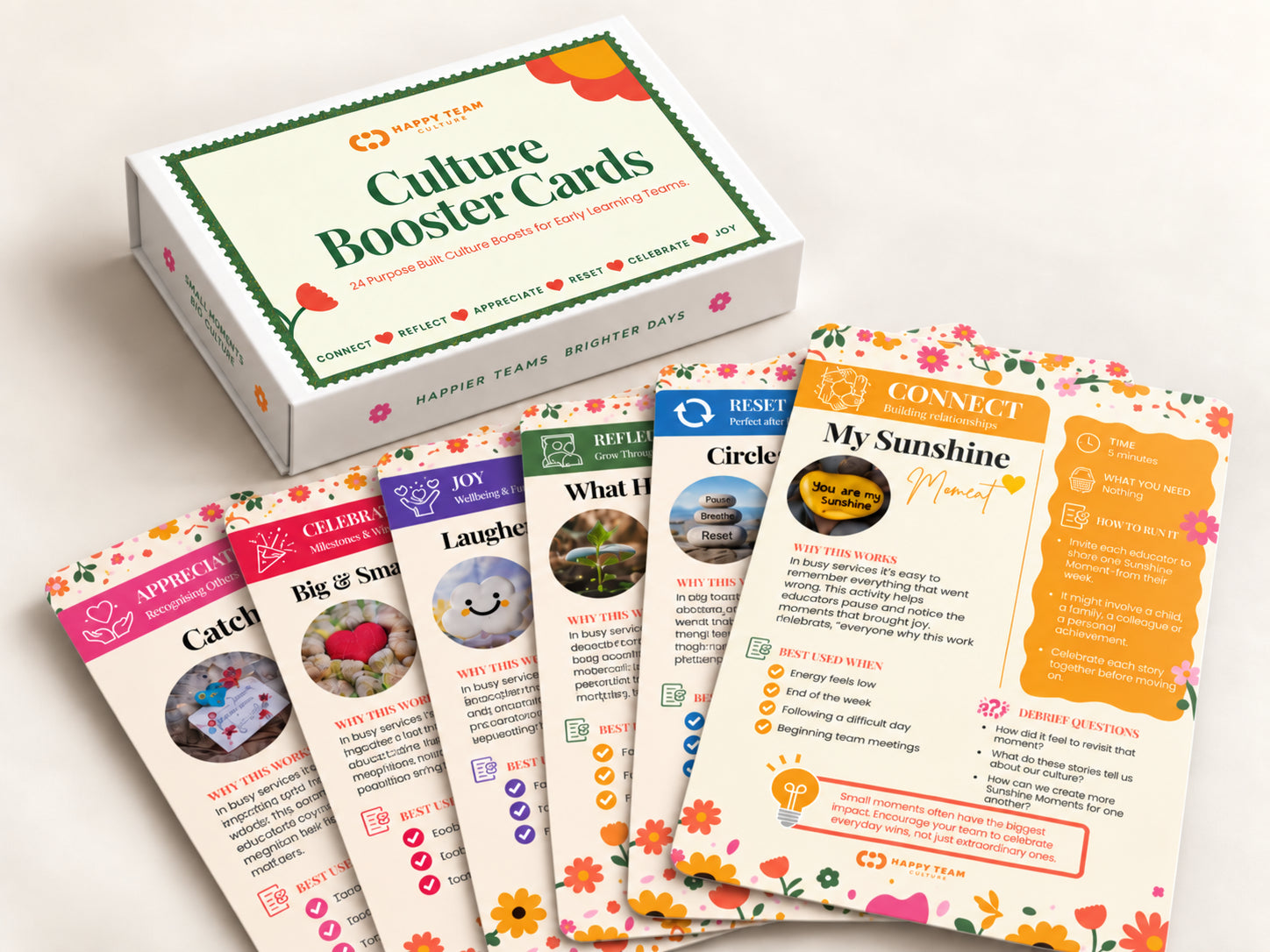
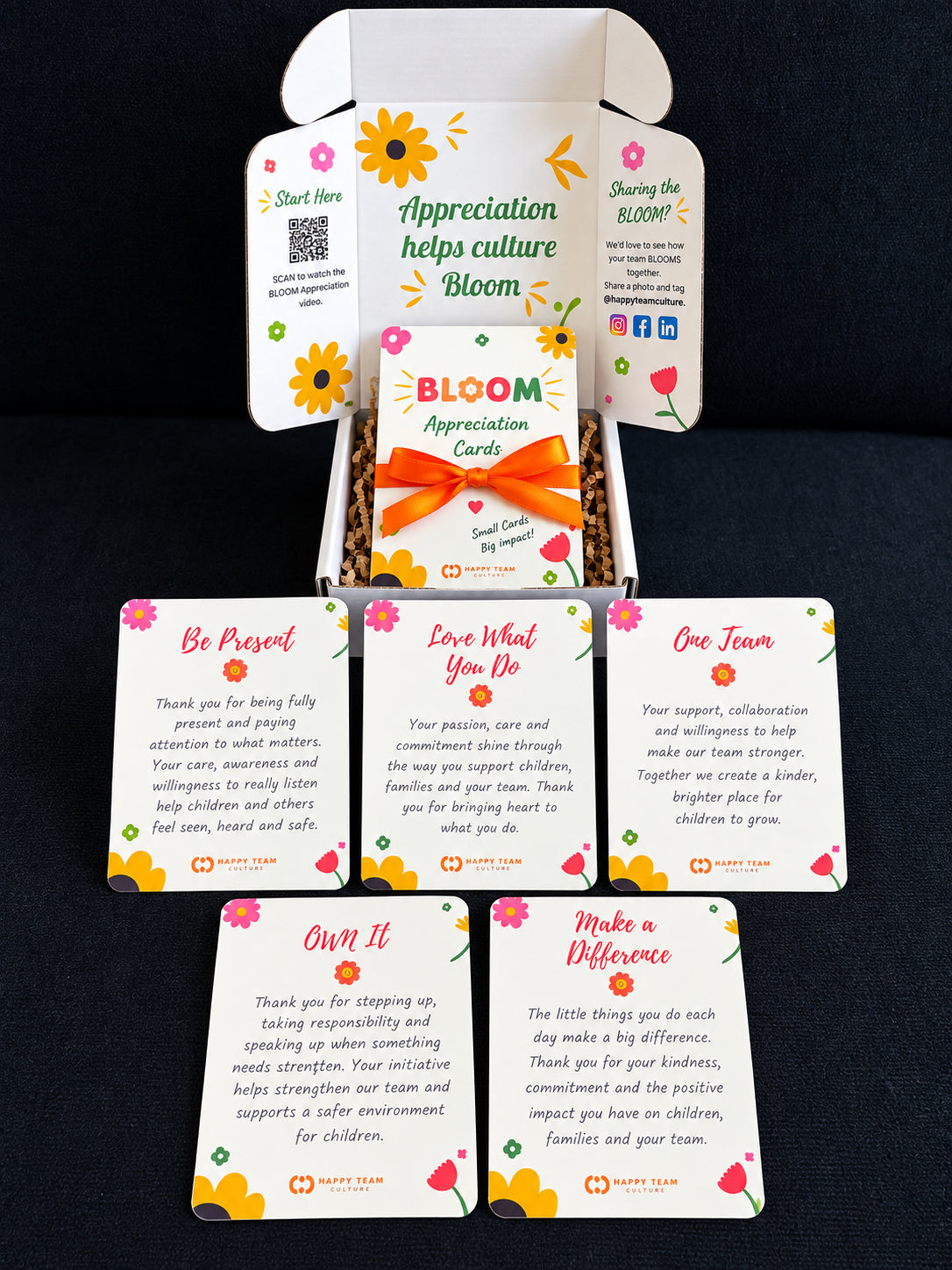
Recognition belongs here too. The BLOOM Appreciation Cards ($150.00) give leaders a simple way to notice, name and celebrate the everyday behaviours they want to see more of, which fits naturally into follow-up conversations and everyday recognition alike. The Culture Booster Cards ($180.00) can help when you want to rebuild connection in the team as a whole, after a difficult review cycle.
Reviews are not a one-off event. Used well, they become one part of an ongoing practice that keeps good educators, supports the ones still growing, and makes your centre a place people want to stay.
Frequently Asked Questions
How often should daycare staff have performance reviews?
Most daycare directors run a formal performance review once a year, then supplement it with shorter check-ins every one to three months. Performance reviews across many industries are often run once a year. The check-ins matter most: they stop a staff member from first hearing about a concern in a formal meeting, and they give you regular chances to notice and name what is going well.
What should a childcare employee performance review include?
A solid review covers the core parts of the role: how the educator plans and delivers learning experiences, how they supervise and respond to children, how they communicate with families and colleagues, and how reliably they meet their responsibilities. It should also include the educator's strengths, two or three clear goals for the next period, and the support you will provide. Keep each point tied to a specific example you can point to, rather than general impressions.
What should you avoid saying during a performance review?
Avoid comparing the staff member with colleagues, bringing up personal circumstances unrelated to work, and making sweeping statements such as 'you always' or 'you never'. Also avoid surprises: anything significant should have been raised earlier in a check-in. Stick to observable behaviour and its impact on children, families and the team, and invite the educator's view before you draw conclusions.
How can educators prepare for a self-evaluation?
Ask educators to think about one or two recent moments they are proud of, one situation they would handle differently, and one skill they want to build. Give them your evaluation criteria in advance so they can measure themselves against the same standards you will use. A short written self evaluation for child care workers, completed a week before the meeting, gives the conversation a shared starting point and helps the educator feel heard rather than judged.
What are examples of performance review comments for childcare workers?
Strong comments describe a behaviour, its effect and a next step. For example: 'During outdoor play you consistently positioned yourself where you could see all children, which kept the group safe. Next term, try the same approach during transitions indoors.' Weak comments such as 'good with kids' give the educator nothing to repeat or improve. Build a small bank of these comments by collecting specific observations throughout the year.
How do you evaluate daycare staff fairly?
Fair evaluation starts with written, role-specific expectations that every educator in a similar position is measured against. Use the same rating scale and form for everyone, base ratings on observed evidence rather than memory, and check your own patterns over time, such as whether you consistently rate some educators more harshly. Involving a second leader in calibrating ratings can also reduce bias.
How can performance reviews help improve staff retention?
Reviews help retention when educators leave the conversation clear about what they are doing well, what matters next, and how they will be supported. Staff who see their development taken seriously are more likely to stay. Reviews that feel like a formality, or that arrive without follow-up, can have the opposite effect. Pairing the review with recognition, such as personal notes of appreciation, and a visible plan for growth makes the process feel worthwhile.

0 comments