

Last Updated: November 16, 2026
Quick Summary
Quotes about early childhood education work because they put a team's purpose into words educators already feel but rarely have time to say. Choose a quote that fits the moment, such as play for a routines conversation or relationships for a team that has been short with each other. Pair it with a question so it sparks a real discussion.
- Pick quotes by purpose, not just theme, so they fit the moment.
- Read one quote at the start of a meeting, then ask one open question.
- Keep one quote per meeting, since more than that stops the team listening.
- Check each quote's source and wording before printing it with a name.
- Name the behaviour a quote describes when you see it in practice this week.
Table of Contents
- Why Quotes Still Work in Early Childhood Education Teams
- Quotes About Early Childhood Education and Play
- Short Early Childhood Education Quotes Inspirational Enough for a Staff Meeting Opener
- Quotes About Child Development and Children's Natural Desire to Learn
- Inspiring Quotes for Early Childhood Educators About Teaching and Relationships
- Quotes for Families, Caregivers and Inclusive Practice
- Checking Quote Attributions Before You Share Them With Your Team
- Using Your Chosen Quote to Lift Your Team This Week
- Frequently Asked Questions
Why Quotes Still Work in Early Childhood Education Teams
A well-chosen quote can settle a noisy staff room faster than a policy reminder. A single line read aloud at the start of a meeting can shift the tone for the next hour. Quotes about early childhood education work because they put the team's purpose into words that educators already feel but rarely have time to say.
The trick is choosing quotes that fit the moment. A quote about play is a good opener before a conversation about outdoor routines. A quote about relationships suits a team that has been short with each other. The collection below is organised so you can pick by purpose, not just by theme.
Quotes About Early Childhood Education and Play
Play is where much early learning happens, so quotes on play are a natural starting point. Here are a few to consider:
"Play is the highest form of research." -- Albert Einstein
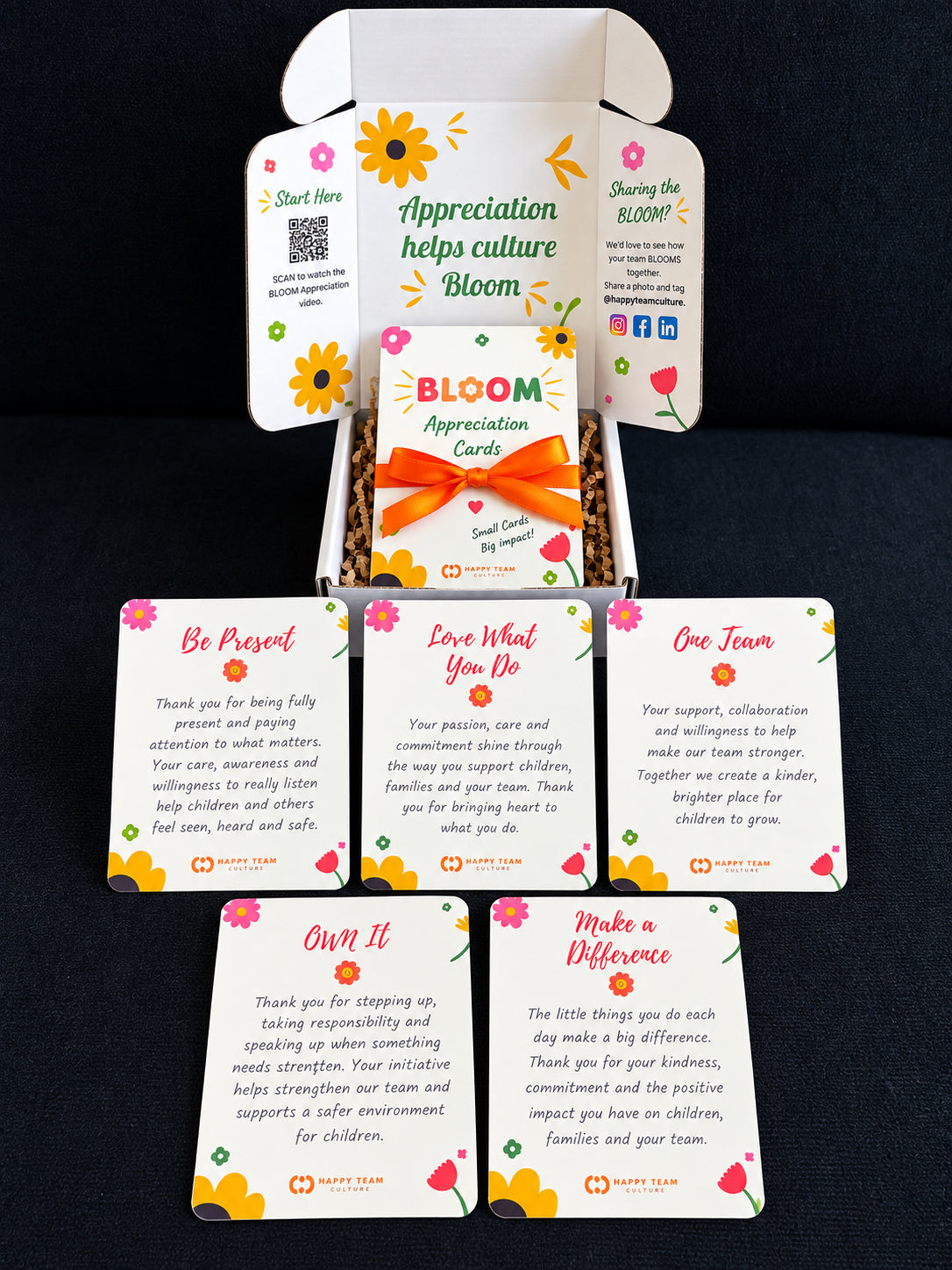
Use this one to open a conversation about why unstructured time matters in your room. Browse Bloom Appreciation Cards to find cards that help you notice and celebrate the everyday play-based moments your team creates. Ask each educator to name one moment this week when a child's play taught them something.
"The work of the child is play." -- Maria Montessori
Share this when reviewing your program. Ask the team whether the day leaves enough room for children to choose and direct their own play.
Pairing a quote with a question keeps it from becoming wallpaper. Ask what the quote looks like in your centre right now.
Short Early Childhood Education Quotes Inspirational Enough for a Staff Meeting Opener
Sometimes you have sixty seconds before the agenda starts. Short lines work best here. Keep one on a card at the front of the room and read it before anyone opens a laptop.
Short quotes also suit a newsletter or a staff room whiteboard. The aim is a moment of shared focus, not a speech. If the team needs longer reflection, move the quote into the discussion itself rather than adding more words to the opener.
Quotes About Child Development and Children's Natural Desire to Learn
This section gives you the quote, a plain-language reading of what it points to, and a question you can ask your team so the quote does something in the room rather than sitting on a wall.
"The child is both a hope and a promise for mankind." -- Maria Montessori
Montessori's line is often used at graduation, but it works better in a team meeting. It reminds educators that development is not a scoreboard, it is a direction. Ask: "Where did you see a child show hope or promise this week, even in a small way?"
"Children are not things to be molded, but are people to be unfolded." -- Jess Lair
This one is useful when a team is over-planning. It nudges educators toward following a child's interest rather than filling every minute. Ask: "What is one interest in your room we could unfold further next week?"
"The goal of early childhood education should be to activate the child's own natural desire to learn." -- Maria Montessori
This is the quote to reach for when programming conversations drift toward worksheets or teacher-led activities. It does not ban structure, it asks whether the structure leaves room for the child's own drive. Ask: "Where in our day does a child get to choose what to pursue?"
"Play is the work of the child." -- Maria Montessori
Short, familiar, and often misquoted. The wording above is the version most commonly attributed to Montessori; if you plan to print it, check the source first (see the attribution section below).
"The wider the range of possibilities we offer children, the more intense will be their motivations and the richer their experiences." -- Loris Malaguzzi
Malaguzzi, the founder of the Reggio Emilia approach, is a name many educators recognize but few quote in meetings. This line is a practical prompt for reviewing your environment: are there open-ended materials, or only single-purpose toys?
A common pattern is that teams discuss development in terms of milestones and checklists. These quotes pull the conversation back to the child's own drive, which is the part educators actually see every day. Keep one quote per meeting, more than that and the team stops listening.
The quotes in this section point to development and learning, and each one comes with a question you can take into your next team conversation.
| Quote | Attributed to | Use it to prompt |
|---|---|---|
| The child is both a hope and a promise for mankind | Maria Montessori | Where did you see a child show hope or promise this week? |
| Children are not things to be molded, but are people to be unfolded | Jess Lair | Which interest could we unfold further next week? |
| The goal of early childhood education should be to activate the child's own natural desire to learn | Maria Montessori | Where in our day does a child get to choose what to pursue? |
| Play is the work of the child | Maria Montessori | Does our setup invite deep play or only supervised activity? |
| The wider the range of possibilities we offer children, the more intense will be their motivations | Loris Malaguzzi | What could we add this week that has more than one use? |
Inspiring Quotes for Early Childhood Educators About Teaching and Relationships
Teaching is relational, and quotes on relationships tend to land well with educators who feel stretched. Choose one that reflects the connection you want to see more of in your team, then ask how it applies to how staff speak to each other, not only to children.
Relationship quotes can also open a recognition conversation. When educators see a colleague living out a value, name it. Recognition that is specific tends to be remembered longer than general praise.
Quotes for Families, Caregivers and Inclusive Practice
Families and caregivers bring their own knowledge of children, and quotes that honour that perspective deserve space in your collection. Use quotes about partnership when preparing for family conversations, and about inclusion when reviewing how every child and family feels welcome in your centre.
When sharing these with your team, ask who in your community might not see themselves reflected in the language you use. Inclusive practice starts with noticing whose voices are missing from the room.
Checking Quote Attributions Before You Share Them With Your Team
Most quote collections online repeat the same lines with the same names attached, and many of those attributions are wrong. The "Play is the highest form of research" line is widely credited to Albert Einstein, but it is often difficult to trace to his published work, so it is worth checking before you attribute it. "The work of the child is play" is often attributed to Maria Montessori, but the exact wording varies across sources. If you put a name under a quote in a newsletter or on a poster and it turns out to be wrong, your team notices, and the quote loses its weight.
Here is a simple verification workflow you can run in five minutes before you share anything:
- Search the exact phrase in quotation marks. Add the word "quote" or "attribution" to the search. If the only results are quote-collection sites, treat the attribution as unconfirmed.
- Look for a primary source. A book title, a speech transcript, an interview, or an official archive is a primary source. A blog post that cites another blog post is not.
- Check the wording against the source. Paraphrases drift. If the source says something close but not identical, either quote the source exactly or label it as a paraphrase.
- If you cannot find a source, change the label. Write "attributed to" instead of a firm name, or use "author unknown." Leaving the name off is better than getting it wrong.
- Keep a note. A simple document listing each quote, its source, and the date you checked it saves you repeating the work next year.
Watch out: a quote that appears on hundreds of sites is not evidence of accuracy, it is evidence of copying. The most-repeated attributions are not always the most verified.
This habit models the careful thinking you want to see in children's learning, and it gives you a ready answer if a family member or a new educator asks where a quote came from. If you display quotes on posters or cards, check the attribution before printing, reprinting is more expensive than checking.
Using Your Chosen Quote to Lift Your Team This Week
Pick one quote from this collection and commit to using it this week. Read it at the start of your next team meeting, then ask one open question: "Where did you see this in our centre recently?" A staff meeting collection can help you build that moment into a meaningful meeting. Let the conversation run for a few minutes before moving on.

Then follow through. Notice the behaviour the quote describes and name it when you see it. The BLOOM Appreciation Cards can help you do this consistently, so a quote about relationships turns into a specific thank-you for a colleague's patience during a difficult drop-off. You can also explore the Culture Booster Cards to see which team connection tools might suit your team.
Small, repeated habits do more for team culture than one big gesture. Start with one quote, one conversation and one act of recognition this week, and see what changes.
Frequently Asked Questions
What are some famous quotes about early childhood education?
Several widely shared quotes come from well-known education thinkers. Jean Piaget's observation that the principal goal of education is to create people capable of doing new things, not simply repeating what other generations have done, is often used in early learning settings. Friedrich Froebel, who founded the kindergarten movement, described play as the highest expression of child development. Before sharing any quote with your team, check the original source, because many popular quotes online are paraphrased, misattributed or altered. A quick search of the original text will keep your team messaging accurate and trustworthy.
What is Jean Piaget's most famous quote?
One of the most frequently cited Piaget quotes is that the principal goal of education is to create people who are capable of doing new things, not simply repeating what other generations have done. It is a useful opener for staff meetings about curiosity and problem-solving. Because it circulates in many slightly different wordings, check a reliable source for the exact text before putting it in a newsletter or on a staff noticeboard. Pairing the quote with one example from your own centre helps it land with educators.
How can a leader use an education quote to start a staff meeting?
Choose one short quote that connects to a current theme, such as curiosity, relationships or play. Read it aloud, then ask each educator to share one moment this week when they saw that idea in action with children. Keep the discussion to five minutes so the quote opens the meeting rather than taking it over. Write the quote on the agenda so the team can refer back to it. This approach works well alongside Culture Booster Cards, which give teams simple prompts for connecting over shared purpose.
How can educators use quotes to inspire their teaching?
Educators can display a short quote in the room, use it as a reflection prompt during planning, or share one in the team's weekly newsletter with a sentence about what it means in practice. The most useful quotes are linked to a specific behaviour, such as waiting patiently for a child's answer or offering a choice during play. Rotate quotes every few weeks so the message stays fresh. Recognising educators when they live out a quote's message is a simple way to reinforce it, and BLOOM Appreciation Cards can help leaders name those everyday moments.

0 comments