

Table of Contents
- Why Simple Appreciation Matters for Childcare Staff Retention
- Childcare Staff Appreciation Ideas That Cost Little but Mean a Lot
- Employee Appreciation Messages for Teachers: What to Say and How to Say It
- Building Appreciation Into Everyday Team Life With Culture Booster Cards
- Legal and Policy Considerations When Giving Staff Gifts
- Inclusion and Accessibility in Staff Appreciation
- How Appreciation Drives Long-Term Retention and Workplace Culture
- Frequently Asked Questions
Last Updated: October 4, 2026
Why Simple Appreciation Matters for Childcare Staff Retention
Simple ways to appreciate childcare staff start with one honest truth: most educators do not leave for a few dollars more. They leave because they feel invisible. Small, steady gestures hold teams together far better than one big annual event.
What Is a Healthy Childcare Staff Turnover Rate?
A healthy childcare staff turnover rate is the share of educators who leave your center in a year while your team still stays stable, experienced, and fully staffed. Many centers find that keeping turnover low matters more than any single perk, because every departure costs time, training, and the trust of children and families.
There is no single official number every center should hit. A common approach is to track your own rate each year and watch the trend, not just the figure. If it climbs, that is your signal to act.
Childcare Staff Appreciation Ideas That Cost Little but Mean a Lot
Childcare staff appreciation ideas do not need a big budget. The gestures educators remember most are specific, personal, and frequent. Here are the ones that hold up best in real centers.
Handwritten Notes and Personalized Gifts
A short handwritten note beats a generic gift card almost every time. Write two or three sentences about something specific you noticed. "You stayed calm with Leo during that hard drop-off, and his mom noticed" lands far harder than "Thanks for all you do."
Pair the note with something personal. A personalized notebook, a favorite snack, or a small plant tied to a comment you remember all work well.
Spontaneous Treats and Team Shoutouts
Surprise matters more than size. A coffee run on a rough Monday, a bag of fruit in the staff room, or a five-minute shoutout at the start of a meeting all lift the room.
Try these low-cost moves:
- Leave a treat on each educator's cubby with their name on it
- Start staff meetings with one specific shoutout per person
- Send a quick message when you catch someone doing something well
- Keep a small stash of snacks for hard days
Employee Appreciation Messages for Teachers: What to Say and How to Say It
Most appreciation messages fail for the same reason: they are generic. "Thanks for all you do" could be sent to anyone, which means it lands on no one. The fix is a repeatable structure, not a better adjective.
The Three-Part Formula
Every message that lands does three things:
- Name the moment. Point to a specific day, child, or situation.
- Name the skill. Say what the educator actually did, not just that they did well.
- Name the impact. Explain who it helped and why it mattered.
Here is the template you can use today:
"Hi [Name], I noticed [specific thing you did] during [specific moment]. It made a real difference because [impact]. Thank you for that."
Ready-to-Adapt Examples by Situation
After a hard drop-off:
"You stayed calm with [child's name] during that tough drop-off this morning.
After covering a gap:
"You stepped into the toddler room when we were short-staffed, and you did it without being asked.
After a quiet win no one saw:
"I saw you reorganize the art shelf so the two-year-olds could reach it safely. Small thing, big difference for their independence."
After a difficult conversation with a family:
"The way you handled that parent meeting took patience and skill.
For a long-tenured educator:
"You have been here [X] years, and the calm in your room is something newer staff learn from.
Delivery Matters as Much as the Words
- Send it the same day. A message about a moment loses its power a week later.
- Match the medium to the person. Some educators want a private note; others light up at a public shoutout. Ask, or watch, and adjust.
- Keep it short. Two or three sentences beats a paragraph.
- Write it down sometimes. A handwritten note on a cubby hits differently than a text.
A Note on Tone and Inclusion
Not every educator wants flowery praise, and not every message should sound the same. Match your tone to the person and the moment. For staff who prefer understatement, a plain, direct thank-you works better than an emotional one. For staff who value public recognition, a shoutout at a meeting may mean more than a private note. The formula stays the same; the delivery flexes.
Building Appreciation Into Everyday Team Life With Culture Booster Cards
Appreciation sticks when it becomes a habit, not a one-off. The hard part is remembering to do it when your week is already full.
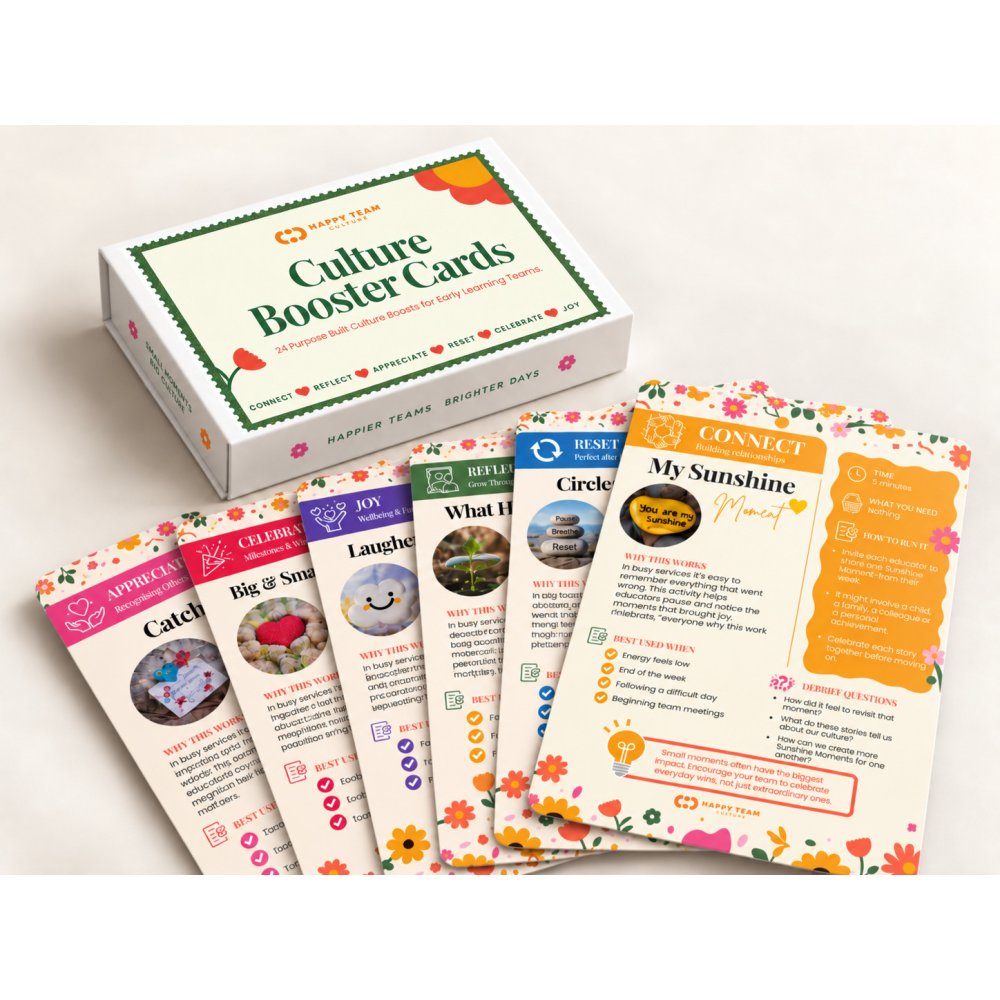
That is exactly why we built our Culture Booster Cards. They are 24 ready-to-use activities sorted into six categories: Connect, Reflect, Appreciate, Reset, Celebrate, and Joy.

The Appreciate category is the one most directors reach for first. It gives you a structured way to help educators feel seen and valued, even on a busy Tuesday.
Legal and Policy Considerations When Giving Staff Gifts
Gifts to staff can carry tax and policy implications, and the rules vary by your center's own policies.
A few practical points to keep in mind:
- Check whether your center has a written gift policy before you buy anything
- Keep gifts modest and consistent so no one feels singled out or left out
- Note that cash and cash-like gifts are treated differently from small non-cash items (De minimis fringe benefits)
- Ask your accountant or payroll provider how staff gifts are treated.
The IRS guidance on employee gifts and fringe benefits explains how the federal tax rules treat small gifts to employees. State rules can differ, so confirm the details that apply to your center before you build a program around them.
Inclusion and Accessibility in Staff Appreciation
Not every educator wants the same thing, and appreciation that ignores this can backfire. A loud group celebration energizes one person and drains another. Food-based gifts miss anyone with allergies, dietary needs, or religious restrictions. Tailoring thoughtful appreciation gifts to individual preferences ensures that your gesture feels personal rather than perfunctory, helping you select items that provide a warm pick-me-up during a long shift.
A fair approach offers choices:
- Let educators pick from two or three small options
- Avoid alcohol and food as your only gesture
- Make sure any event works for staff with mobility or sensory needs
- Rotate the format so both quiet and outgoing team members feel included
The goal is simple: every person on your team should be able to receive appreciation in a way that actually feels good to them.
How Appreciation Drives Long-Term Retention and Workplace Culture
Appreciation is one of the cheapest retention strategies you have, and one of the most effective. But "it feels good" is not a business case. Here is the mechanism, and here is how to prove it is working.
Why Recognition Changes Whether Educators Stay
Turnover in early care and education is driven less by pay alone than by how supported and respected educators feel day to day. When a director notices specific work, three things shift:
- Belonging. An educator who feels seen by leadership is less likely to scan job boards during a hard week.
- Identity. Recognition reinforces that this is a profession, not just a job, which matters for educators weighing a move to a higher-paying field.
- Reciprocity. People tend to stay where they feel invested in. Small, steady gestures create that sense of mutual investment.
The U.S. Department of Labor's guidance on workplace flexibility and retention points to supportive workplace practices as a key factor in keeping good staff. Appreciation sits right alongside flexibility and fair pay in that picture.
The Real Cost of Losing One Educator
Most directors underestimate what a single departure costs. When you add it up, replacing one educator typically involves:
- Recruiting and advertising time
- Interview and screening hours pulled from classroom coverage
- Onboarding and orientation days
- Weeks of reduced-ratio coverage or substitute pay while a new hire ramps up
- Lost family trust when a familiar face leaves a room
You do not need a precise dollar figure to make the case. Track your own numbers: hours spent hiring, days of coverage gaps, and the number of families who comment when a teacher leaves. That internal evidence is more persuasive to a board or owner than any national average.
How to Measure Whether Appreciation Is Working
You cannot manage what you do not track. Four simple metrics, reviewed quarterly, tell you whether your appreciation habits are moving the needle:
- Voluntary turnover rate, departures you did not initiate, divided by average staff count, tracked year over year.
- Average tenure, how long educators stay, in months. A rising number is the clearest sign your culture is holding.
- Stay-interview themes, ask long-tenured staff why they stay. Their answers tell you what to protect.
- Exit-interview themes, ask departing staff what was missing. "I never felt noticed" is a fixable problem; "I needed more money" is a different conversation.
Turning Appreciation Into a Habit, Not an Event
Consistency is where most centers fall short. A practical rhythm looks like this:
- Weekly: one specific shoutout per educator, in person or in writing
- Monthly: one team-level gesture, rotated so it does not always look the same
- Quarterly: review your turnover and tenure numbers and adjust
- Annually: a larger celebration that reflects the year, not a substitute for it
Appreciation is not a replacement for fair pay, adequate staffing, or professional development. It is the layer that makes those things land. When educators feel seen week after week, they stay longer, engage more, and bring that energy into their rooms.
Frequently Asked Questions
How do I express gratitude to daycare staff without spending much money?
Focus on personal, low-cost gestures. A handwritten note naming a specific moment you noticed, like staying late to help a child settle, costs nothing and often means more than a generic gift. Spontaneous treats such as a coffee run or a shared snack in the staff room also work well. The key is intentionality: match the gesture to the person and deliver it soon after the effort you want to recognize. Simple appreciation ideas like these build team morale without straining a tight budget.
What is a healthy childcare staff turnover rate?
Tracking your own rate year over year matters more than chasing an industry number, because small centers with strong culture can outperform larger facilities. If your rate is climbing, start with consistent appreciation and check whether your recognition reaches every team member.
How often should you recognize childcare staff for their hard work?
Recognition works best when it is frequent and specific rather than saved for annual events. Aim for some form of acknowledgment every week, whether that is a verbal shoutout in a staff meeting, a quick note in a cubby, or a team message. End-of-year celebrations are valuable, but they cannot carry a whole year of morale on their own. Regular, small gestures of gratitude build the daily workplace culture that keeps educators engaged and reduces turnover.
What should employee appreciation messages for teachers and childcare educators include?
Effective appreciation messages name a specific action and its impact. Instead of a generic 'great job,' try: 'Thank you for rearranging the reading corner this week. The children noticed, and it made transitions calmer.' Keep it short, sincere, and personal. Written messages work well for staff who prefer quieter recognition, while public shoutouts suit those who enjoy team acknowledgment. Ask your team which they prefer, and vary your approach so appreciation feels thoughtful rather than routine.
High turnover drains your time and your team's spirit. Child Care Leadership Hub helps you turn appreciation into a daily habit with practical tools built for Early Learning leaders. Our Culture Booster Cards give you 24 ready-to-use activities across six categories, including Appreciate, so you can lead meaningful moments without extra planning. Get started with Child Care Leadership Hub and build a team that feels valued every week, not just once a year.
0 comments