

Last Updated: November 21, 2026
Quick Summary
A team debrief is a short, structured conversation where your team reflects on a difficult event together. Hold it as soon as the people involved can sit down, usually 15 to 30 minutes, and cover what happened, what went well, what was hard and what you will do next time.
- Hold the debrief on the same day or the next morning, while details are fresh.
- Include everyone directly involved in the event, plus the leader running the session.
- Run it for 15 to 30 minutes, adjusting shorter when the event was minor.
- Use four questions: what happened, what went well, what was hard, what we do next time.
- Agree on one or two practical actions, not five, and name who owns each one.
Table of Contents
- Why a Team Debrief Matters After a Hard Day
- When to Hold a Team Debrief and Who Should Attend
- How Long Should a Team Debrief Take?
- A Team Debrief Script You Can Use Tomorrow
- The Four Questions for a Staff Debrief
- A Team Debrief Example From a Real Centre Day
- Keeping Your Team Connected After the Debrief
- Frequently Asked Questions
Why a Team Debrief Matters After a Hard Day
A team debrief is a short, structured conversation where your team reflects on a difficult event together. For Early Learning leaders, it is one of the most practical ways to protect staff wellbeing and keep your centre running well. Done well, a debrief helps educators feel heard, surfaces what went wrong, and gives the team a clear next step.
The research supports this. A systematic scoping review on the evidence behind debriefing describes the main goal of debriefings as improving outcomes by learning through discussion and reflection on events, then carrying that learning forward. That is exactly what you need after a rough day.
Many leaders skip the debrief because it feels like one more thing on a full plate. We get it. But a team that never talks through hard moments tends to carry them quietly. That is where resentment, gossip and burnout start.
The short version:
- A debrief turns a bad day into shared learning
- It gives educators a safe place to say what happened
- It sets up clear actions so the same problem is easier next time
When to Hold a Team Debrief and Who Should Attend
Hold the debrief as soon as the team can sit down together, ideally on the same day or the next morning. Waiting too long means people forget details or stew on them alone.
Keep the group focused on those who were involved. A debrief for a difficult incident works best with the educators who were there, plus you as the leader. Bringing in people who were not part of the event can make the conversation feel like gossip or blame.
Here is a simple rule of thumb:
- Include: everyone directly involved in the event
- Include: the Centre Director or the leader running the session
- Consider separately: staff who need individual follow-up
- Avoid: adding people who were not there
If someone was deeply affected, do not force them into a group setting. A quick one-on-one check-in can come first. Our TeamSTEPPS guidance on short, facilitated debriefs notes that debriefs should stay short and focused, which matches what we see in centres.
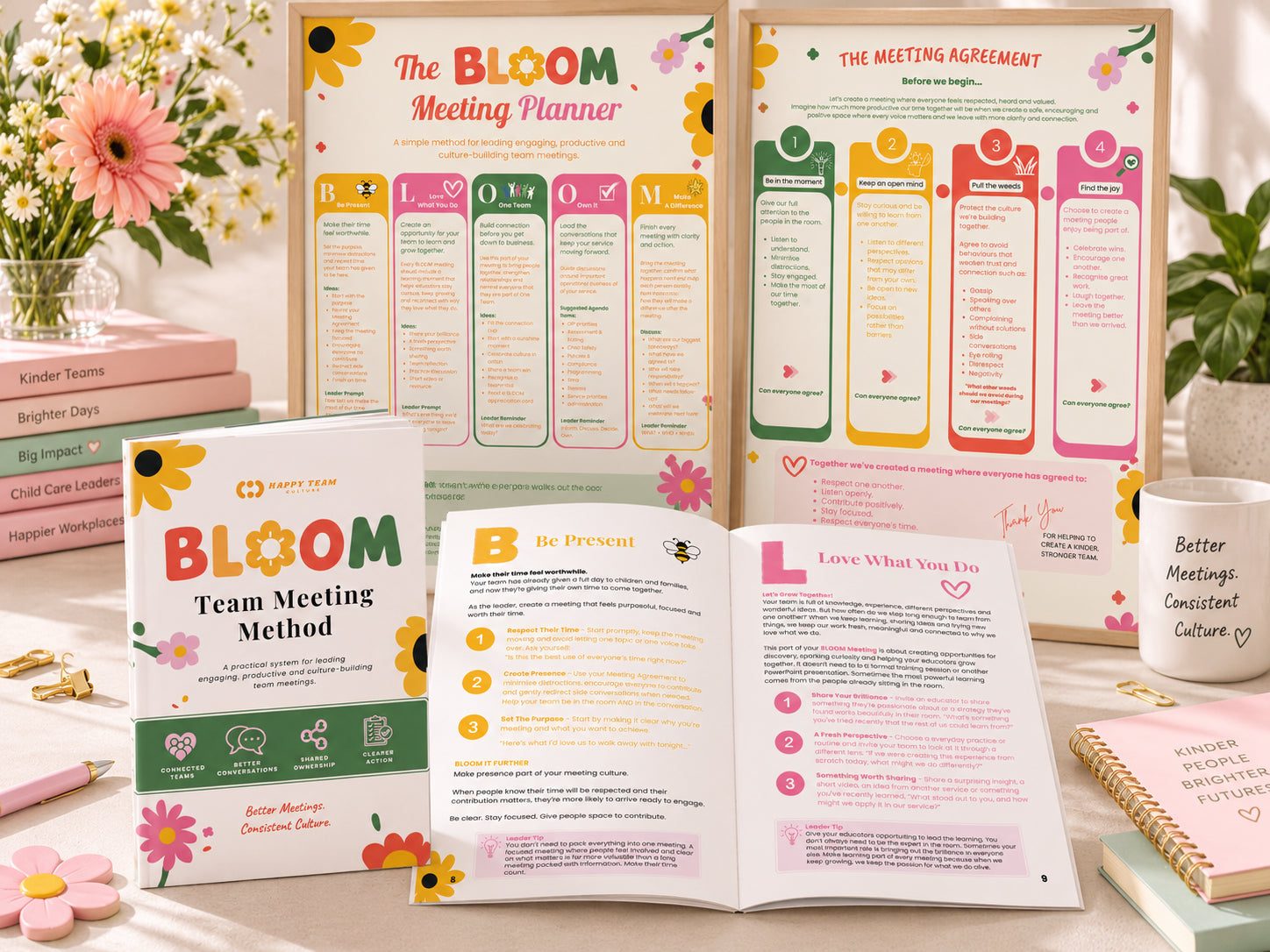
For regular team connection outside of crisis moments, the BLOOM Staff Meeting Method gives you a structure for bringing reflection into everyday staff meetings.
How Long Should a Team Debrief Take?
A good team debrief usually runs 15 to 30 minutes. That is long enough to cover the key points and short enough that tired educators will actually stay present.
Here is a timed agenda you can run tomorrow. Treat the minutes as guardrails, not a stopwatch.
- 0-3 minutes: Open and set the frame. Thank people for coming, name the day plainly, and state the purpose in one sentence: "We're here to look after each other and work out what we'll do next time, not to work out whose fault it was." Set two or three ground rules out loud: speak for yourself, no names in a blaming way, what's said here stays here.
- 3-10 minutes: Rebuild the timeline. Ask the group to walk through what happened in order, one step at a time. Your job is to keep it factual. If someone jumps to "and that's because she didn't...", redirect: "Let's park that and finish the timeline first."
- 10-20 minutes: What went well, what was hard. Take the good moves first, this settles the room and stops the conversation tipping straight into fault-finding. Then open the harder question: "What was the hardest part for you?" Let silence sit. Count to five before you fill it.
- 20-27 minutes: Agree one or two actions. Not five. Ask: "What's the one thing that would make this easier next time?" Write it down where the team can see it, name who owns it, and name the day you'll check back.
- 27-30 minutes: Close and check in. Thank people specifically for what they contributed, then say what happens next. Before people leave, quietly check the person who looked most affected and offer a one-on-one.
Aim for the shorter end when the team is exhausted or the event was minor. Use the full 30 minutes when the day was genuinely hard and people need time to speak.
Watch out: the most common failure is letting the timeline block swallow the actions block.
Keep an eye on the clock, but stay flexible. If someone is clearly upset, it is fine to pause the agenda and check in on them first.
If you are running debriefs regularly, the BLOOM Staff Meeting Method gives you a repeatable structure so this agenda becomes a habit rather than a one-off rescue.
A Team Debrief Script You Can Use Tomorrow
Having the words ready makes a huge difference. You do not need to sound polished. You just need to sound calm and genuine.

Try this opening:
"Thanks for sitting down with me. Today was a tough one, and I know some of you are still feeling it. This isn't about blame. We're here to look at what happened, look after each other and decide what we'll do next time."
Then move into the body of the debrief with a few simple prompts:
- "Let's start by walking through what happened, one step at a time."
- "What went well during the day, even in the middle of the difficulty?"
- "What was the hardest part for you?"
- "What do we want to do differently next time?"
Close with a clear next step:
"Thank you all for being honest. Let's agree on the two things we'll follow up on this week, and I'll check in with each of you by Friday."
Calm body language helps too. Sit at the same level as your team, keep your voice steady, and let silence sit for a moment before you fill it.
To keep the mood warm and connected, the Culture Booster Cards include ready-made reflection and reset activities you can use to open or close a debrief when the room needs a lighter touch.

The core prompts for a debrief are easy to keep handy; here is the sequence at a glance.
| Step | What to say or do | Timing |
|---|---|---|
| Open | Thank the team and state that this is not about blame | Start |
| Walk through the event | Ask people to describe what happened, one step at a time | Early in the session |
| What went well | Name the good moves, even small ones | Middle of the session |
| What was hard | Ask what the hardest part was and let silence sit | Middle of the session |
| What we do next time | Agree on one or two practical actions | Near the close |
| Close | Thank everyone and confirm your check-in by Friday | End |
The Four Questions for a Staff Debrief
If you remember nothing else, remember these four questions. They work in almost any difficult situation:
- What happened? Let people describe the event in their own words.
- What went well? Name the good moves, even small ones.
- What was hard? Give space for honest feelings and frustrations.
- What will we do next time? Agree on one or two practical actions.
The questions are simple. Running them safely is the skill. Here is how to handle the three moments that trip most leaders up.
When blame creeps in. It usually sounds like "the problem was..." followed by a name.
When the quiet voices stay quiet. The loudest person is rarely the whole story.
When people disagree. Two educators can honestly remember the same event differently. Do not referee. Say: "It sounds like we saw it differently, and that's okay. What matters is what we do next time." Then park the detail and move to question four.
When not to debrief, and when to refer on. A team debrief is a routine reflection, not clinical support. If someone is acutely distressed, cannot stop crying, is dissociating, or describes symptoms that are not settling, do not push them through a group process.
Keep the focus on the situation, not on personalities. For more on setting clear, respectful communication norms, our article Simple Ways to Appreciate Childcare Staff offers ideas for keeping morale positive, and How to Stop Gossip in Workplace: 7 Practical Steps gives direct scripts for stopping rumours before they grow.
A Team Debrief Example From a Real Centre Day
Here is an example of how a debrief might look in practice. Names and details are illustrative.
A toddler room had a day with a serious playground injury. The staff handled it well, but the team felt shaken and a few educators were quietly blaming one another. The Centre Director called a 20-minute debrief the next morning.
She opened with ground rules, then asked the group to walk through the timeline. Someone said the first aid response had gone smoothly. Someone else said the handover to the afternoon team had been rushed. Instead of arguing about whose fault it was, the team agreed on one change: a clearer checklist for end-of-day handovers.
The director closed by thanking everyone and checking in with the educator who had been most affected. The change was small, but the team left feeling heard and clear about what came next.
Keeping Your Team Connected After the Debrief
A debrief should not be a one-off. The days after matter just as much. Follow up on the actions you agreed on, and let the team see that their input led to something real.
Recognition helps here. When educators handled a hard day with care, say so specifically and soon. The BLOOM Appreciation Cards make it easy to notice and name those moments without adding more work to your week.

Recognising Your Team's Efforts Afterwards
A short, genuine thank you can do more than a long speech. Name what you saw: "You stayed calm with the family and kept the other children settled. That mattered." Specific praise tells educators their effort was noticed, and it helps them feel valued after a tough day.
Over time, these small habits build a team that talks openly, looks out for each other and bounces back faster from hard moments.
Frequently Asked Questions
How long should a team debrief take?
Most team debriefs after a difficult day work well in 15 to 30 minutes. Keep it short enough that people can still stay on top of their rostered duties and their own wellbeing. Start with what went well, spend the bulk of the time on what was challenging and what you'll do differently, and finish by naming one or two clear next steps. If the conversation needs more time, schedule a follow-up rather than stretching the session past its useful length.
What four questions should you ask in a staff debrief?
A simple set of four questions keeps the conversation focused: What happened? What went well? What was challenging? What will we do differently next time? Ask each question in turn, invite everyone to contribute, and avoid pointing fingers. Writing the answers down on a whiteboard helps the team see the conversation moving forward and makes it easy to turn the last question into agreed actions.
What should you do if a team member becomes upset during a debrief?
Pause, acknowledge what they are feeling, and let them know they can step out for a few minutes if they need to. Don't push for detail while emotions are high. Check in with them privately after the debrief and, if the distress is significant or lingers, point them towards your service's wellbeing supports or an appropriate professional. Your job is to keep the room safe, not to solve every feeling in the meeting.
How do you debrief a team without blaming anyone?
Focus the conversation on the event and the processes around it rather than on individuals. Ask open questions such as what got in the way, rather than who did it. Set the expectation at the start that the debrief is about learning, and gently redirect any blame back to the situation. Thank people for speaking honestly, and make sure the outcome is a shared improvement rather than a list of individual faults.

0 comments