

Last Updated: November 19, 2026
Quick Summary
Quick staff meeting activities are short, no-prep exercises that take under ten minutes and need nothing but people in a circle. Try Two Truths and a Classroom Tale, the Gratitude Round or the Listening Pair to shift the room's energy before the agenda starts. Keep each one timed, go first yourself and close with a simple debrief question.
- Two Truths and a Classroom Tale takes six to eight minutes and needs no materials.
- The Gratitude Round runs three to five minutes with one sentence each around the circle.
- The Listening Pair gives each educator three uninterrupted minutes to speak while the other listens.
- If you say five minutes, stop at five so your timings stay credible.
- Read back notes from the One Question Round next meeting and say what you have actioned.
Table of Contents
- Why Quick Staff Meeting Activities Change the Room
- Team Building Activities for Early Childhood Educators That Take 10 Minutes or Less
- Child Care Staff Meeting Ideas for Building Trust and Communication
- No Prep Team Building Activities Classroom Leaders Can Run Tomorrow
- Quick Childcare Staff Meeting Activities Free of Cost and Fuss
- How to Facilitate These Activities So Your Team Actually Engages
- Choosing Your Next Staff Meeting Activity
- Frequently Asked Questions
Why Quick Staff Meeting Activities Change the Room
A staff meeting that opens with a quick connection activity feels different within about ninety seconds.
At Child Care Leadership Hub, we hear the same thing from directors again and again: the meeting itself isn't the problem, it's the flat, tired energy in the room before anyone has spoken.
The research on how early childhood teams actually spend their meeting time is thin.
That's the case for keeping activities short, purposeful and repeatable. Below, we'll walk through twelve ideas that fit any schedule, plus how to facilitate them so your team actually engages rather than rolling their eyes.
Team Building Activities for Early Childhood Educators That Take 10 Minutes or Less
Ten minutes is a practical sweet spot. Long enough to shift the mood, short enough that nobody starts watching the clock. The three below are the ones we reach for first because they need nothing but people and a circle, and each one comes with a clear finish line so you can stop on time.

The Two Truths and a Classroom Tale Opener (6-8 minutes)
Materials: none. Group size: best with six to ten; split into pairs if you have more.
Each educator shares two true facts about themselves and one exaggerated "classroom tale" from their week. The group guesses which one is invented. Give everyone thirty seconds to think before you start so the quieter educators aren't caught cold.
It works because it's playful without being silly, and it lets people reveal personality in a low-stakes way.
Debrief question: "What's one thing you learned about someone that you didn't know before today?"
The Gratitude Round (3-5 minutes)
Materials: none. Group size: any; go around the circle once.
One sentence each, going around the circle: something a colleague did this week that made your day easier. No discussion, no replies, just naming it out loud.
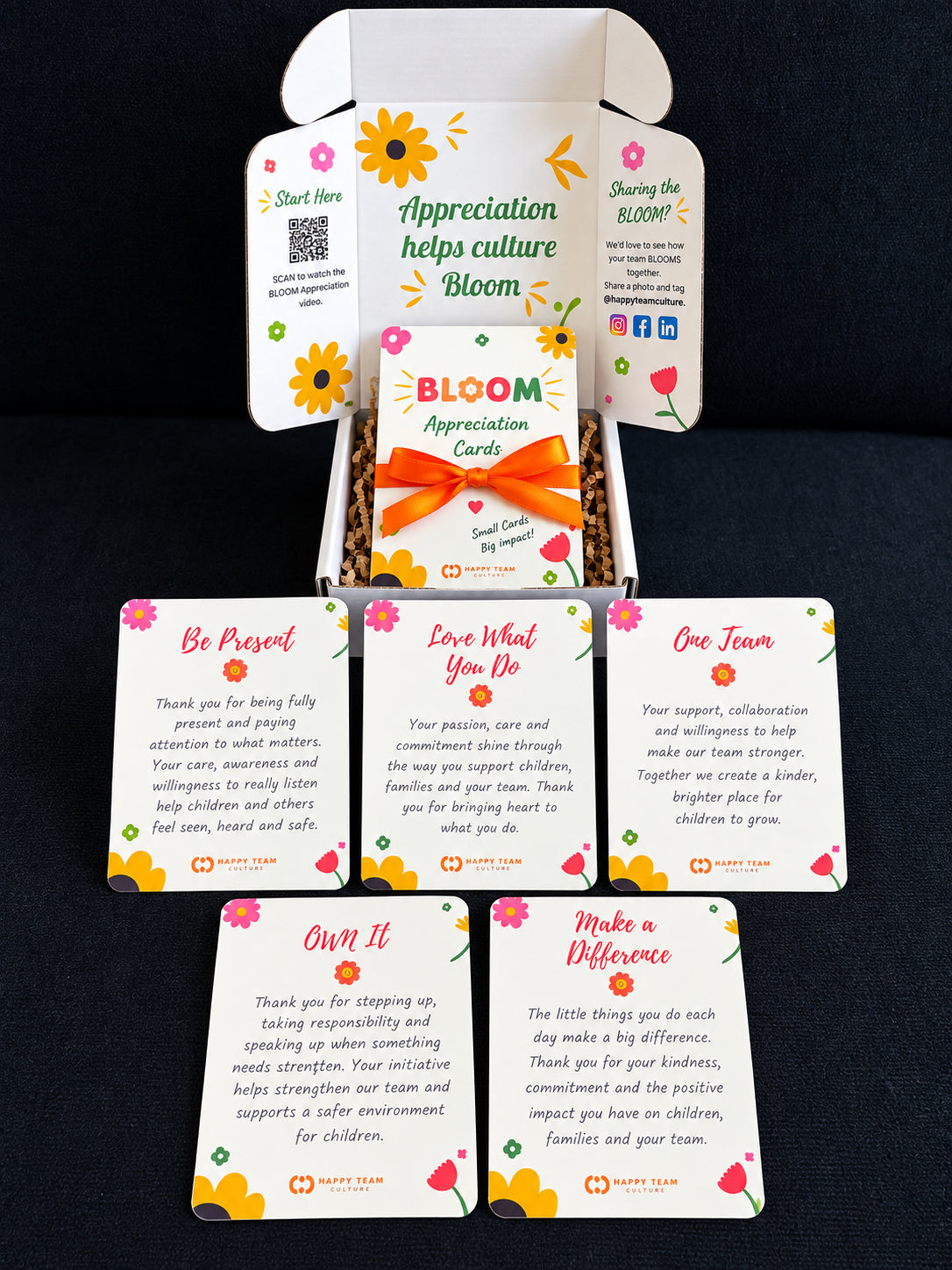
This is a quick appreciation activity you can run in a few minutes. It also feeds naturally into the BLOOM Appreciation Cards, which help leaders notice and name the everyday behaviours worth celebrating rather than waiting for a special occasion.
Debrief question: "What did you notice about the kinds of things people thanked each other for?"
The Handoff Huddle (8-10 minutes)
Materials: none, though a whiteboard or butcher's paper helps. Group size: four to twelve.
This one is built specifically for childcare settings. Ask the group to name the small moments in the day where information passes between educators, the morning handoff, the sleep-room changeover, the end-of-day family update. Write them up as the group calls them out.
It's quick, but it surfaces the routine friction that generic team-building games never touch. The same two or three handoffs can come up again and again, which gives you a genuine agenda item for next month rather than a game that ends when the timer does.
Debrief question: "Which of these is worth us solving first, and who wants to own it?"
Adapting these for real centre schedules
Not everyone can be in the room at once. If your team is split across shifts, run the Gratitude Round twice, once at each end of the day, and read the first group's contributions aloud to the second. For educators who prefer not to speak in front of the group, offer a written option: a sticky note on the wall that you read out anonymously.
If you want a deeper collection of options, our article on engaging activities for staff meetings has more no-prep ideas you can rotate through the year.
Child Care Staff Meeting Ideas for Building Trust and Communication
Trust doesn't build through one big team day. It builds through small, repeated moments where people feel heard. The two activities below do this particularly well in a childcare setting, and both come with the steps, timing and debrief prompts you need to run them tomorrow.
The Listening Pair (8 minutes)
Materials: a timer. Group size: any even number; pair up, and join in yourself if you have an odd number.
Pair educators up for three minutes each way. One speaks about a genuine work challenge, a room that isn't working, a family conversation that went sideways, a routine that keeps breaking down, while the other listens without interrupting or problem-solving. Swap, then debrief with one question: what was hard about not jumping in?
Debrief question: "What did the speaker do that made you feel heard, and what did the listener do that helped?"
Watch out: three minutes feels long to people who aren't used to it, so keep the timer visible and stop it firmly. If you let it run, the exercise turns into a chat and the listening lesson disappears.
The One Question Round (5-7 minutes)
Materials: a notebook for the leader. Group size: up to twelve; if you're larger, split into two groups and have a co-leader take the second.
Ask each person to answer a single question, such as "what's one thing you wish I knew about your room right now?" The leader listens and takes notes without responding. This is where active listening stops being a theory and becomes something your team can feel.
Debrief question: "What did it feel like to be asked and not answered straight away?"
Making it stick beyond the meeting
A common mistake is treating these as one-offs. Run one every few weeks and the pattern can start to shift how people talk to each other on the floor, not just in the meeting. The simplest way to make that happen is to close the loop: at the next meeting, read back the notes from the One Question Round and say what you've done about one of them.
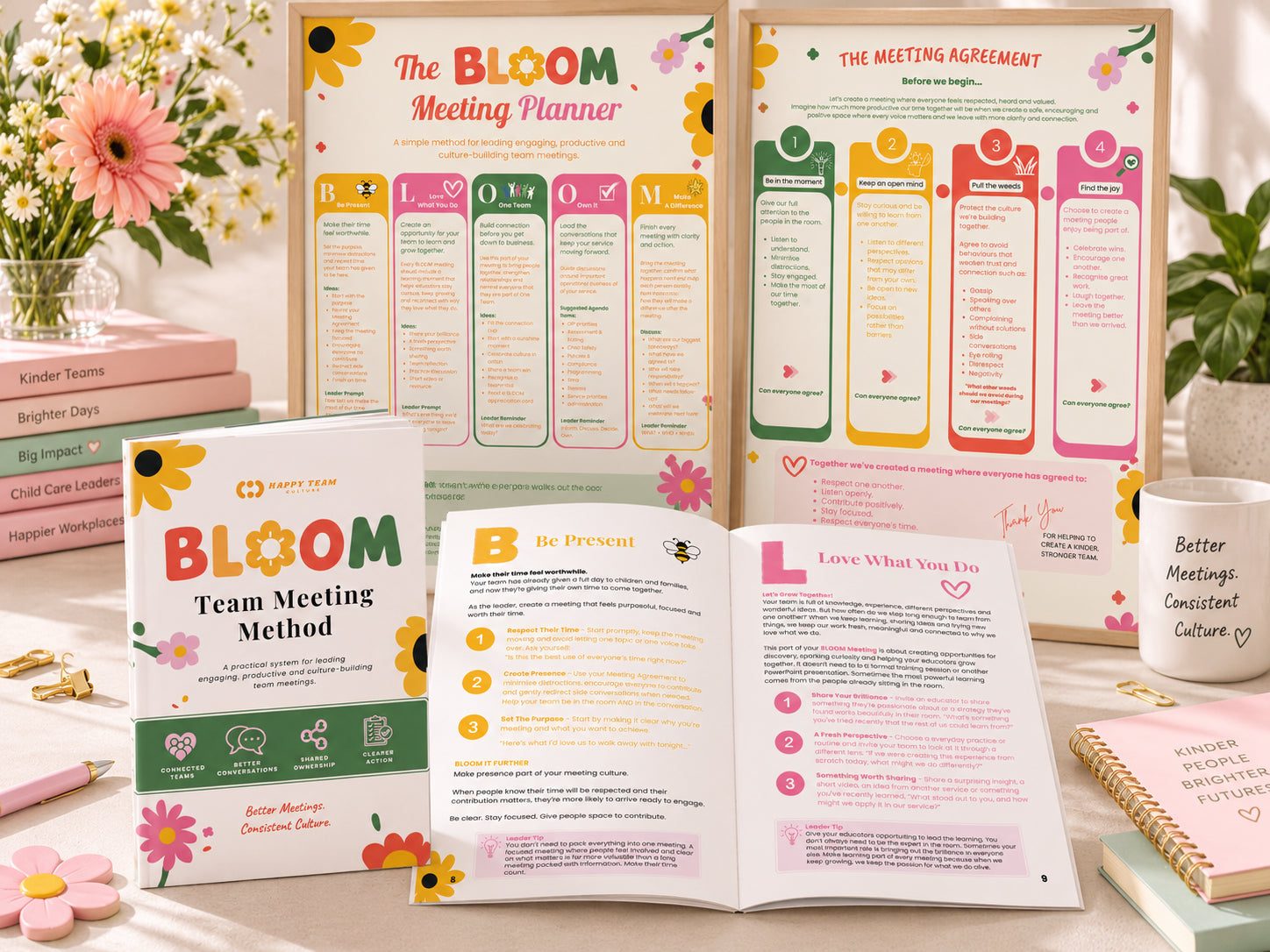
If you want a repeatable structure for running meetings this way, the BLOOM Staff Meeting Method gives you a clear framework to follow before, during and after each meeting, so connection activities become part of the rhythm rather than an afterthought.
No Prep Team Building Activities Classroom Leaders Can Run Tomorrow
No prep means no printing, no supplies, no planning the night before. These three fit that brief.
1. The Appreciation Pass. Each educator names one thing a colleague did well that week. Two minutes total.
2. The Energy Check-In. Everyone shares a number from one to five and one word explaining it. No elaboration required.
3. The Shared Win. The group names one thing that went well across the whole centre this week. One minute, one answer.
Each of these takes under five minutes and needs nothing but people in a circle. If you want a deeper collection of options, our article on engaging activities for staff meetings has more no-prep ideas you can rotate through the year.
Quick Childcare Staff Meeting Activities Free of Cost and Fuss
Nothing on this list needs a budget. Leaders shouldn't need to justify spending to build a connected team.
Free activities work best when they're tied to something real rather than dropped in as filler. A wellness challenge where each educator commits to one small habit for a fortnight, checked in briefly at each meeting, costs nothing and builds shared accountability.
A circle activity where each person shares one thing they're looking forward to this week takes ninety seconds and lifts the room. A movement activity like a two-minute stretch break mid-meeting resets flagging energy better than another coffee.
For more budget-friendly ideas, our guide to child care team building under budget is worth a read before your next planning session.
How to Facilitate These Activities So Your Team Actually Engages
Facilitation is where most quick activities succeed or fail. The activity itself is rarely the problem. The way it's introduced, timed and closed is.
Here's what we've found works:
- Explain the why in one sentence. "We're doing this because I want everyone's voice in the room before we get into the agenda."
- Go first yourself. Leaders who participate rather than observe get far better buy-in.
- Keep the time. If you say five minutes, stop at five. Overrunning teaches the team that your timings aren't real.
- Close with a debrief question. "What did you notice?" is enough. It turns a game into learning.
- Rotate the facilitator. Shared ownership of the meeting builds shared ownership of the culture.
If you want a repeatable structure for running meetings this way, the BLOOM Staff Meeting Method gives you a clear framework to follow before, during and after each meeting, so connection activities become part of the rhythm rather than an afterthought.
Choosing Your Next Staff Meeting Activity
Match the activity to the problem in front of you, not to whatever looks fun on a list. That's the whole decision.
| If your team needs... | Try this | Time |
|---|---|---|
| A warmer, less flat room | Two Truths and a Classroom Tale | 6-8 min |
| More appreciation between colleagues | The Gratitude Round | 3-5 min |
| Better listening and trust | The Listening Pair | 8 min |
| A quick energy reset | The Energy Check-In | 2 min |
| Shared ownership of culture | Rotating facilitator plus debrief | Ongoing |
If you're still deciding, our staff meeting planning templates for directors help you slot the chosen activity into a clear agenda without adding to your planning load. And if you'd rather have ready-made options you can pick up and lead, the Culture Booster Cards give you 24 activities across six categories, so you can choose the boost your team needs on the day.
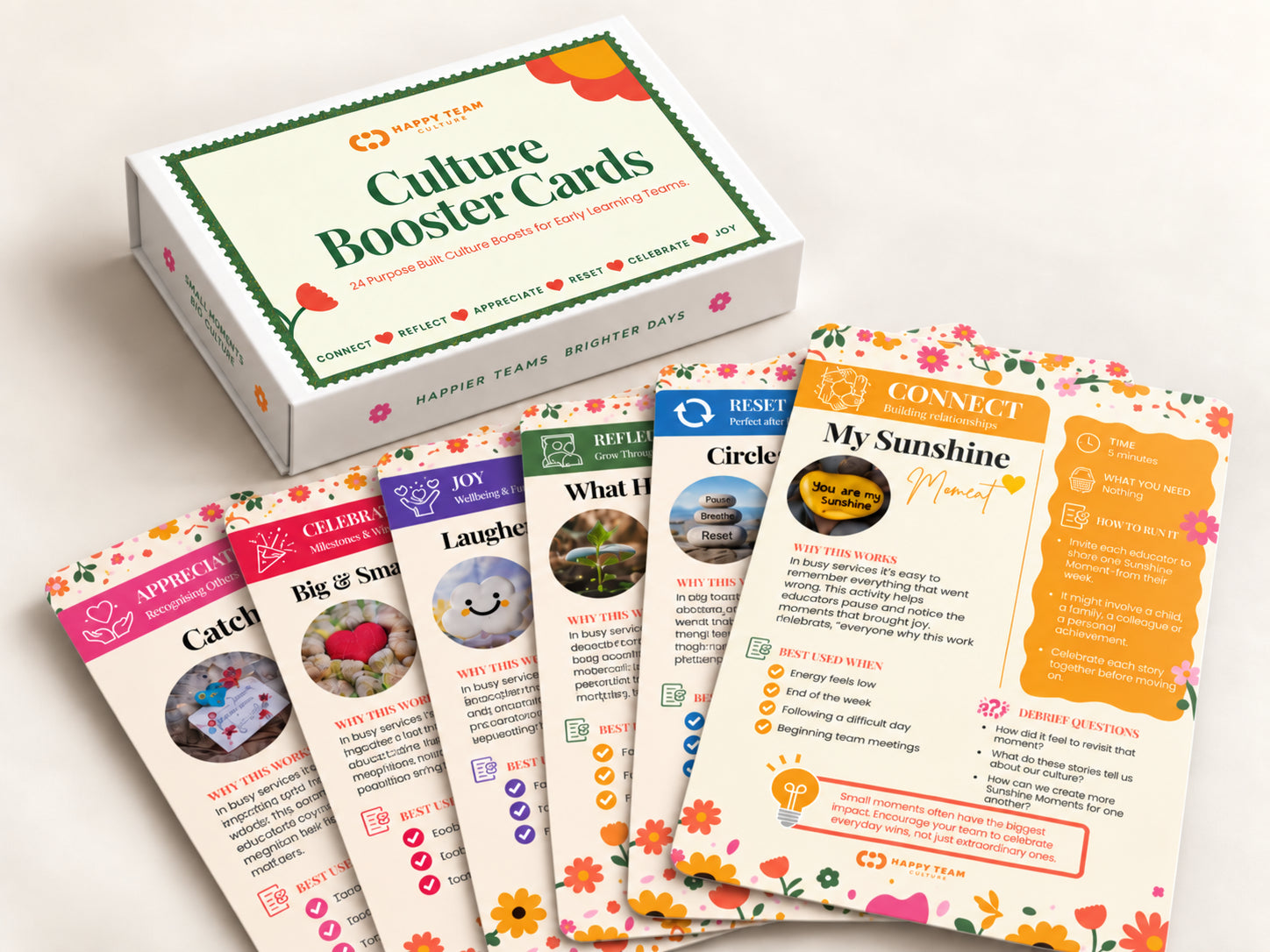
Building a team culture that lasts doesn't require a big budget or a complete overhaul of how you run meetings. It requires small, consistent moments where your educators feel seen, heard and connected. Child Care Leadership Hub exists to make those moments easier to create, with practical tools like the Culture Booster Cards, the BLOOM Staff Meeting Method and the BLOOM Appreciation Cards.
Frequently Asked Questions
What are some fun activities to start a staff meeting?
A quick round of Two Truths and a Classroom Tale gets people talking within five minutes, and a Gratitude Round works well when your team is tired and needs something gentle. Both need no materials and no preparation. The key is choosing something that fits the mood of the room, not just the calendar. If your team has had a heavy week, lead with connection rather than energy.
What are effective team building activities for daycare staff?
The activities that work best for daycare staff are short, low-pressure, and connected to the work they already do. A 10-minute paired listening exercise builds trust faster than a longer game, because educators get to speak and be heard. Rotate activities across meetings so nothing feels repetitive, and always close with a short debrief question so the activity connects back to how the team works together.
How can I make childcare staff meetings more engaging?
Start with connection before content. Open every meeting with a five-minute activity, keep the operational section tight, and finish with something that sends people out feeling positive. Vary the format so team members do not predict the same structure every time. A ready-made structure helps here, and the BLOOM Staff Meeting Method gives you a framework for before, during, and after the meeting so engagement is planned rather than hoped for.
What are some no-prep team building activities for educators?
Circle questions, paired listening, and quick appreciation rounds all need zero materials. For a no-prep team building activities classroom option, try a one-word check-in where each person describes their week in a single word, then invite two people to say more. These activities take under 10 minutes and work with any team size. The only preparation is choosing your question in advance.
Time needed for quick staff meeting activities

0 comments